MIMEO MIMEO #8 CURATORS' CHOICE


Mimeo Mimeo #8, The Curators’ Choice Issue, went to press today with essays by: Steve Clay; Wendy Burk; Tony White; Brian Cassidy; Thurston Moore; J.A. Lee; Michelle Strizever; Adam Davis; Michael Basinski; Joseph Newland; Alastair Johnston; Tate Shaw; Michael Kasper; Steve Woodall; Molly Schwartzberg; Nancy Kuhl; James Maynard; and Various Authors from Utah. http://mimeomimeo.blogspot.com/

AMERICAN BOOK REVIEW


The new American Book Review has a focus on Lost and Found books edited by me with essays by Mimeo Mimeo's own Jed Birmingham (The Archive of Interzone) as well as: Danny Snelson (Archival Penumbra); Steve Clay (The Dig); Brad Freeman (A to Z Recovery); and Megan Paslawski (Publishing's Restorative Properties). The whole issue is terrific and available at: http://americanbookreview.org/

Marketing Blitz


"Scarce, with OCLC showing only two institutional holdings."  So touts a rare book dealer in marketing Blitz, a mimeo mag out of La Grande, Oregon from 1964-1966, edited by Mel Buffington and Bobby Watson.  I am not going to lie, information on Blitz is scarce.  According to Christopher Harter's Index, there were three  issues.  From what I can gather the magazine initiated out of a university campus like so many mimeos of the period.  In this case, the campus in question is Eastern Oregon University.

I have been collecting for over 20 years and I must admit that bookseller references to the OCLC always confuse me.  What does the above reference to two institutional holdings mean?  It does not refer to Blitz #1 or #2 as those issues are in multiple institutions. It must mean the complete run.  The University of Colorado - Boulder and University of Wisconsin - Madison have the run.  Most other institutions do not even acknowledge the existence of Blitz #3.  Strangely, Utah State has just Blitz #3, in its Charles Potts Collection.

Blitz #1 and #2 have Bukowski appearances so they will never be impossible to obtain.  By 1964-1965, Bukowski was already collectible, so I am sure issues are sitting around in personal libraries, to say nothing of the almost 20 institutions that have Blitz #1 and/or Blitz #2.  Furthermore, Allen Ginsberg and da levy appear in Blitz #2.  Again two highly collectible poets.  Collectors and institutions were following Ginberg's every move by 1965.

Clearly Blitz #3 is the "scarce" issue, with a possible shift in editorship as Jan Kepley becomes involved.  If a complete run is in only two institutional holdings, then say so.  Do not imply that Blitz #1 and Blitz #2 are completely off the radar of institutions and collectors.  True rarity is a truly rare thing.  As it should be.

JB

Polluted Lake Series


Atkins, Russell. DISTANT THE SOUND, Polluted Lake Series, No. 1
Cleveland: Renegade Press, 1965
First edition, stapled printed wrappers, 4.25" x 6", 12 pages, letterpress. (T&H P-43)

Cook, Geoffrey. “WOUND...”, Polluted Lake Series, No. 2
Cleveland: Renegade Press, 1965
First edition, stapled printed wrappers, 2" x 5", 16 pages, letterpress. (T&H P-44)

Albrecht, Erik. “OH4286AW...”, Polluted Lake Series, No. 3
Cleveland: Renegade Press, 1965
First edition, stapled printed wrappers, 5" x 4.5", 12 pages, letterpress, cover art by Dave Williams. (T&H P-45)

Taylor, Kent. “MIST...”, Polluted Lake Series, No. 4
Cleveland: Renegade Press, 1965
First edition, stapled printed wrappers, 5.5" x 4.5", 12 pages, letterpress. (T&H P-46)

Salamon, Russell. CONFLICT IN SONATA FORM, Polluted Lake Series, No. 5
Cleveland: Renegade Press, 1965
First edition, stapled printed wrappers, 5.5" x 4.5", 12 pages, letterpress. (T&H P-47)

levy, d.a. "ASTER F..., Polluted Lake Series, No. 6

Cleveland: Renegade Press, 1965
First edition, stapled printed wrappers, 5.5" x 4.5", 12 pages, letterpress. (T&H P-48)

Morgan, Edwin. SCOTCH MIST, Polluted Lake Series, No. 7
Cleveland: Renegade Press, 1965
First edition, stapled printed wrappers, 5.5" x 2", 16 pages, letterpress. (T&H P-49)

Houedard, Dom Sylvester. VIENNA CIRCLES, Polluted Lake Series, No. 8
Cleveland: Renegade Press, 1965
First edition, stapled printed wrappers, 5.5" x 2.5", 12 pages, letterpress. (T&H P-50)

Dogin, Sam. SHIT TARGET, Polluted Lake Series, No. 9
Cleveland: Renegade Press, 1965
First edition, stapled wrappers made from wallpaper, 6" x 8.75", 2 pages, photocopy. (T&H P-51)

Cornillon, Susan Koppelman. SUSAN UNDER JOHN, Polluted Lake Series, No. 10
Cleveland: Renegade Press, 1965
First edition, stapled printed wrappers made from wallpaper, 5" x 3.5", 12 pages, letterpress. (T&H P-52)

Denis, Alan [pseud. d.a. levy]. SLEEP, FOR SAINT RONALD JUMP, Polluted Lake Series, No. 11
Cleveland: Renegade Press, 1965
First edition, stapled printed wrappers, 8 pages, 4.5" x 2", letterpress. (see Lowell B3, T&H P-53)

dagmaR. SHADOWS OVER LAKE ERIE, Polluted Lake Series, No. 12
Cleveland: Renegade Press, 1965
First edition, stapled wrappers made from wallpaper, 4.75" x 4", 8 pages, letterpress and mimeograph. (T&H P-54)

Reference: Kent Taylor and Alan Horvath's Bibliographies (Kirpan Press, 2006, 2008)

JB

levy As Folk Art


THE MARRAHWANNA QUARTERLY, Vol. 1, No. 1

Cleveland: Renegade Press, 1964
First edition, stapled sheets with printed cover, 150 copies, letterpress. Contributors include: Russell Salamon: V (AFTER PYNCHON), John Keys: PRESCOTT VIA HUDSON, d.a. levy: SHIPENSBURG, Roberta E. Badger: PLEASE, Margaret Randall: THE BROKEN GLASS BEGINS TO WHOLE ITSELF, Marvin Malone: THE PROFESSIONAL, Ann: FALL, J. Cornillon: POEM, Dave Rasey: MIDWESTERN MANIFESTO, Erik Kiviat: [UNTITLED POEM], d.a. levy [print]: YOU MURDERERS WITH YOUR INDIFFERENCE, Allen Katzman: THE TRANSGRESSION, George R. Beck: TWO BROTHERS, Judson Crews: MEDICAL SCIENCE, Pat Crayton: [untitled print] (Lowell B2, T&H P-38)

Is it an insult to d.a. levy to think of his printing efforts in terms of folk art?  Why should that thought come to me?  Is levy a naive artist?  Does his youth imply a certain immaturity?  A lack of sophistication?  A lack of talent?  I do not think so.  Nobody says this of Ed Sanders or Ted Berrigan.  Fuck You, a magazine of the arts and C:  A Journal of Poetry are now viewed as high art.  They are bought, sold and displayed in New York galleries.  Is it because levy is from Cleveland and outside of the art capital of the world?  Maybe it is more accurate to view levy as outsider art, like that of Henry Darger.  levy as obsessive.  His printing the product of madness and compulsion.  Can all the publications of the Mimeo Revolution be viewed in the same terms?   

JB

Crossing Streams


Jason Davis has come through yet again and sent me a ton of images of Mimeo Revolution classics that were not feature in Secret Location.

From Jason:

LONG DONGS, edited by d.a. levy
Cleveland: 7 Flowers Press, 1966
First edition, stapled sheets tipped into printed wrappers, 5.5″ x 8.5″, 30 pages, 300 copies, letterpress and mimeograph, cover art by Beorna, contributors: Joe Nickell, Steve Richmond, Douglas Blazek. (T&H P-77; DenBoer A1)

"This is Blazek's first book appearance (A1 in DenBoer's Blazek bibliography even though I suppose it's an anthology of sorts). While it's not the first published intersection of Blazek and levy (Blazek appeared in the M Quarterly #2, and #4 in 1965 and they appeared together in multiple mags together that year including Blitz#2, Border Vol.1, No.3,Gooseberry Vol.1, No.2, Input 5, and more; levy also appeared in Ole 2 in the same year), it's the first non-periodical appearance for Blazek, a milestone, and one wrought by levy... long dongs indeed..."

levy and Blazek cross streams here and like in Ghostbusters such a merger is powerful stuff.  The results could literally destroy the universe.  Long Dongs is described as a Blazek stopper.  It is a wonder that such categories actually exist.  Yet there is a Blazek bibliography so there are Blazek collectors.  The experience of reading through Ole tells me that this is as it should be.  Blazek, like Sanders and Berrigan, is a mimeo icon.  Likewise Long Dongs is a mimeo classic.

JB

Let the Man Talk: The Beacham Show at Boo-Hooray: Are You Listening?


I have been talking about and talking up Jon Beacham for years.  It is not really necessary on my part.  As this interview (with Joshua Beckman) for Guernica Magazine proves, he can do just fine for himself.  See http://www.brooklynrail.org/2013/02/books/joshua-beckman-and-jon-beacham-with-erika-anderson.  It is a fantastic interview which revolves around their collaboration project Porch Light but spins off into interesting directions from there.  The interview gives one of the best articulations I have seen to date of Beacham’s philosophy of printing and art.  I laugh writing that, as Jon would tell me I am full of shit.  Philosophy!  Art!  The Art of Printing!  Jon wrestles with such things in his conversation and in his work.  I have been reading Douglas Blazek’s OLE very closely of late and you see that same low tolerance for bullshit with Blazek.  Blaz wrote in an introduction to OLE, “To hell with artiness and pretentiousness.”  That could be Jon talking. 

But fortunately or unfortunately the bullshit is true.  Like Blazek, Jon is “arty” and his work is pretentious if that means his work is steeped in literary and artistic history.  If it means that Jon knows what he is doing (and not doing) and knows who he is and what his work is about.  Blazek and Bukowski were pretentious for sure.  The difference between Beacham and the leisure poets that Blazek and the Meat School hate so much is that Beacham talks the talk and walks the walk.  See http://thebrotherinelysium.com/.  His work is a way of life, not a lifestyle.  The reference here is to Burroughs and Junkie.  Beacham’s work is quite simply the axis around which his life revolves.  Everything feeds back into it.  Everything relates to it.  Beacham, like Burroughs in Junkie, is paranoid and obsessed. 

If Jon can speak for himself, his work speaks volumes as well.  I think the Boo-Hooray show will bear this out.  See http://www.boo-hooray.com/thebrotherinelysium/.  The art gallery is a forum that allows Jon’s work to express itself in the courtly environment of the market.  I would prefer hearing Jon riff or blow at the bookstore in Beacon or in a loft or in a print shop but that is another matter I will address later.  What the show at Boo-Hooray suggests this that there is an audience out there that is receptive to listening to Jon and the work.  I certainly hope so because talking to Jon over the past five to six years and listening to the work which I have been lucky to obtain (which is the time period covered by the show) has been some of the most insightful and rewarding conversations I have had.

JB

"mag? what?": Douglas Blazek on Bulletin From Nothing


Charlie Plymell designed the cover to OLE #7:  The Godzilla Review Issue, so Blazek should have had some idea what he was getting into when he received the Plymell printed issues of Bulletin From Nothing by Beach and Pelieu.  Yet Blaz was completely befuddled . . . and delighted.  As for the question of "mags? what?", Gwen Allen has safely categorized Bulletin From Nothing as an artist magazine in an effort to safely harness the Bulletin’s frenzied energy into the all-consuming, always running gallery and museum market.  Not to worry, the Bulletin has been stuffed and mounted and is now over $300 an issue.  As for Blazek’s plea for a reprint, step right into the Studio and take a peek.  The men and women are still ALL NUDE:  http://realitystudio.org/bibliographic-bunker/bulletin-from-nothing/

From OLE #7
BULLETIN FROM NOTHING #1    $1.50                     all frm:  Beach Texts &
BULLETIN FROM NOTHING #2    $1.00                     Documents / c/o City Lights
LIFE BEGINS WITH LOVE                                98 cents               Books / S.F.

frm reading these 3 bks (mags? what?) i am convinced that they originated the word “turn on” -- the electric mattress that played ‘toot’ to the cockroache’s red laugh!!  if these are not available anymore i hope to hell that somebody reprints them because they are invaluable, esp for the collages -- all of the fantastic -- galactic embraces with Creative Mammoths – a Batman’s “POW is an aborted double bubble bubble compared to these mag!  they are TURN-ON – they possess secret wires that connect in electrical hard-on ecstasy to yr skull the instant you slip a copy in yr hands.  there is a chick who has a G.I. Joe bayonet for a cock & 2 grenades for balls.  there are the 2 musclel men fags one saying:  “Back off, sir!  You can’t approach this ship” & the other replying:  “I’m the test pilot, airman!  And don’t fire that thing at me again!”  neither of them have pulled up their jockey shorts yet.  there is the collage of a hunk of steak looking like sea shore boulders & in the center, on the sand, emerging frm a shell or clam or an inner tube are a nude man & a nude woman.  the meat has a butcher’s knife stuck in it.  these 3 mags (books? what?) are guaranteed to make you slam doors, throw light bulbs at yr postman, tie a pink bikini on yr Beagle -- they are guaranteed to make you see black acrobat spiders mazing thru the yellow veins of the Sun’s Bat Drool!  they are guaranteed to make you buy a shot gun loaded w/LSD & shoot Jonathan Swift as he walks between the crack in the sidewalks & unscrews air caps on 1928 Rolls Royce Limousines.  they are guaranteed to . . . HELL!  do I have to go thru all this fantasy just to avoid using the word “GREAT”?! 

JB

The Latest from Division Leap and the Greatest from Renegade Press


Division Leap recently released an e-mail catalog dedicated to d.a. levy and the Cleveland Scene.  The list is small but all the real precious stuff, like gold and drugs, are measured in ounces anyway.  See the list here:  http://www.divisionleap.com/akd52/images/pdfs/dalevy.pdf.

They also released another catalog on artists books:  http://www.divisionleap.com/akd52/images/pdfs/artistsbooks.pdf

Check them out.
In order to celebrate the latest from Divison Leap, here is a catalogue from Ole #2, attempting to place the output of Renegade Press in amber.  Thankfully, levy’s publications have proven to be the essence of quicksilver, or maybe a Silver Cesspool.

AN INCOMPLETE RENEGADE PRESS CATALOGUE

KING LORD, QUEEN FREAK – ed sanders $2
FAREWELL THE FLOATING CUNT – d.a levy $2
PARENTHETICAL POPPIES – Russell salamon $1
SUBWAYS – dave rasey 50 cents
SELECTED POEMS  -- Judson crews 50 cents
THE BLOODLETTING – allan katzman $1
OBJECTS 2 – russell atkins 50 cents
SELECTED POEMS  -- kent taylor $1
WHO IS DEAD? – Irene schramm
MORE WITHDRAWED OR LESS – d.a. levy $1
THE VULNERABLE ISLAND – carol berge 50 cents
DREAMS AT THE TEA TABLE – geo rbt beck $1
BRUSHED POEMS & A LITTLE PUTSCH  -- richard allen morris 50 cents
VARIATIONS ON FLIP – d.a. levy o.p
FRAGMENTS OF A SHATTERED MIRROR – d.a. levy
ALEATORY LETTERS -- kent taylor $1.50
POEMS OF THE GLASS --  margaret randall $1
CORNPONETONEPOEM – carl heckman 50 cents
PHENOMENA -- russell atkins $1
PURGATORY & CAROUSELS – jay billera $1.50

JB

Bukowski Preaching the Gospel


Ole opens with a quote by Charles Bukowski:  "Poetry is dying on the vine like a whore on the end stool on a Monday night."  His poem "Watchdog" is the mag's first poetic statement.  The poem is unattributed and missing the last line.  My copy has "Buk" and "that" written in in pencil.  Possibly by Blazek.  Maybe not.  In any case, the annotations were totally unnecessary.  The poem could be by nobody but Bukowski.  The voice is unmistakably his from the first line.  Buk is the Cerebrus that guards the pages of Ole.  You had to pass his sniff test.  He could smell the stench of artifice the minute it wafted into the bar.  Along with Blazek he was the Ole's critical doorman:.  To enter you must "first of all cancel all your subscription to the Kenyon Review and come here to Ole where you have to squint at what you read and laugh because we can't spell or punctuate."

That line comes from his "A Rambling Essay on Poetics and the Bleeding Life Written While Drinking a Six-Pack (Tall)," which, for my money, is the most important piece in all of Ole.  This is Ole's defining manifesto, of which there were many.  For example, Issue Two, which ends with "A Rambling Essay" also has an incredible introduction by Blazek, Blazek's "A Proposal" and several book reviews, which lay out loud and clear the Ole ethos.   Blazek holds his own and holds down the fort alongside Bukowski.

But throughout the eight issues of Ole, there is the voice and formidable presence of Bukowski.  His poems speak for themselves (and for Ole) but reading through Ole, particularly Issue Two and the Godzilla Issue, what struck me was Bukowski's critical voice.  With "A Rambling Essay," he stands tall as Ole's leading theoretician.  The six-pack of talls was a mandatory part of the stance.  The drunken prophet preaching his crazy wisdom to the initiated.  As I mentioned in an earlier post, it is no mistake that Bukowski takes on Zukofsky as theoretician in his review of A Test of Poetry in The Godzilla Issue as well as standing toe to toe with Allen Ginsberg, the most famous poet in the world.

Bukowski was the genius of the Ole crowd.

JB

The Velvet Underground and Charles


My friend Charles sent me some photographs he took a little while back.  I was listening to The Velvet Underground on Pandora when I opened his email.  Venus in Furs should have been playing but I think it was Neil Young's Sugar Mountain instead.  So much for serendipity, but it was a pleasant surprise getting his photos anyway.

Contact Charles if you like the photos:  ctalkoff@yahoo.com

JB

You're Fucked If You Do; You're Fucked If You Don't


For the most part, the guys of Ole have it ass backwards in their views on women.  In issue after issue, there are poems dicking around with rape imagery.  Not surprisingly, the Ole reviews treat women poets roughly.

I will start off with a Steve Osterlund review of Diane di Prima because it is out of character.

"SEVEN LOVE POEMS FROM THE MIDDLE LATIN  trans. by Diane di Prima / The Poet's Press / Box 951 / Poughkeepsie, N.Y.   $1.25

I'm prejudiced -- she's wonderful, and this book's as well-done as VARIOUS FABLES FROM VARIOUS  PLACES.  Beautiful, erotic air about it."

Buk on Kathleen Fraser is much more typical.

"CHANGE OF ADDRESS AND OTHER POEMS -- Kathleen Fraser, $1.50, Kayak Books, c/o Bindweed Press, 2808 Laguna St., San Francisco, California.

The light innuendo supposed to be tipped, flared, with doom and insight.  Old causations masked as New Reality.  Bunkum.  NEW YORKER stuff.  No wonder the world has gone to hell -- stick a knife in the average poet and he (she) will only hiccup.

The cure for generals is Art.  The cure for stupidity is Art.  The cure for asthma, Falling hair, near-sightedness, boils, hiccups is Art.

Art is a bottle of whisky, a ride down the Ganges, a good night's sleep, a white dog.  But where are you going to find it?

The lady poets have go to show me more than the dull comfortable agony of looking out of the window between a cup of coffee and the vacuum cleaner while poppa is out there getting machine-gunned to a time-card or pewked upon a a business conference.

I would dull the reader with excerpts except that the reader is dull enough already."

So go the Ole poets, lady poets do not fuck enough or just need a good fuck.  Unfortunately even those lady poets who fuck, do not seem to fuck right.

Here is Gerard Van Der Leun on Lenore Kandel.

"THE LOVE BOOK by Lenore Kandel / Stolen Paper Review / 55 Mountain View Mill Valley / Calif.  94941 / $1.00

THE LOVE BOOK, better known as 'the busted book', is neither erotic, illuminative, inspirational, enlightened, or poetic.  Its tone blares histronics that have little linguistic viruosity // writhing language jumping and spinning talking you into it // here, in this book, lacking.  Orlovsky:  'I don't wanna tell you about God, make ya holy or good, give ya beauty.  I wanna make ya cum'  // Ginsberg:  The tongue and cock and asshole are holy!' //

Kandel says fucking is god is fucking is divine is good.  //  Agreed.  But the question is what are you like in bed?  //  Themes and things in the poem center on the absolute cosmic geewhiz of it all. // Galactic strobelights fucking fucking fucking legs thighs bellies breadcrumbs bottles gorgons gods kamas and sutras meaty mouths on flesh cocking cunting fucking sucking going to and coming from inside outside pulling massive folds of ad hoc labia over the head and in frenzy disappearing  //  into air // thin air // shouting words typographic insistence on relevancy of all to all -- but nothing happens except print patterns on the retina fading.

Professing orgiastic freedom // But something held back // An unwillingness or inability to get down to it // to physical description that builds into something // that is physical in its movement // She writes:  'The lust of hermaphroditic deities doing/inconceivable things to each other. . ." // which reads like Kurtz's 'unspeakable sins' in 'Heart of Darkness' because if the things in the vision get inconceivable, that is the point where the poet has got to start conceiving, and tell, in detail, just what they are doing out there in the void.

But sometimes tenderness and things human appear out of the general jumble:  'at night   sometimes i see our bodies glow" // 'we are covered with each other my skin is the taste of you" //

Kandel is a better poet than these poems; has written things moving and true // But LOVE BOOK runs on the idea that saying makes it so // but it is the saying itself that must happen // be the thing // not a report after the fact // Must be union and loving // Not the stains on the sheets when the lovers have gone // elsewhere."

JB

Hate Ashbery


Despite being household names, Olson and Ginsberg are two of the most misspelled poets in the canon.  Olson as Olsen you see everywhere from book reviews to academic journals to blog posts.  Given Allen Ginsberg's name recognition you would think people had his name down, but the hairy guru's name spells double trouble for his many readers and admirers.  Allan Ginsberg, Alan Ginsberg, Allen Ginsburg.  You get the idea.

John Ashbery's poems are well-known for being difficult to read and understand.  The same goes for his name.  Asbury, Ashbury, Ashberry.  The boys of Ole manage to misread Ashbery in almost every possible way.  I think this comes from pure ignorance, but maybe not the type you would think.  The Ole poets wear their anti-intellectualism on their sleeves but their mauling of Ashbery's name is not symbolic of their being ignorant of Ashbery in terms of awareness or understanding.  Instead, they choose to simply ignore him and, in fact, the entire New York School.  Rare is the mention of Frank O'Hara, James Schuyler, Kenneth Koch or Ashbery in the pages of Ole.  The same goes for Berrigan and Company.  I was surprised that the publications of C Press were not reviewed in The Godzilla Issue.  The inclusion of Angel Hair Books publications is the exception that proves the rule.  In fact, you will flip through Ole in vain for any mention of the big name NYC mimeos:  definitely no C, Fuck You or Floating Bear.  Minor nods to Kulchur and Angel Hair.

For the Ole poets, New York was the symbol of forced and flaccid Art and Intellectualism and nobody would represent that more than John Ashbery and, so it seems, the publications of C Press (I will have to dig deeper on this; I have to think Berrigan corresponded and interacted with Blazek on many levels.).  It also seems that the Ole crew sniffed out something rotten in with Sanders and Fuck You (note to dig deeper on this as well).  Maybe the stench of Artiness as represented by Freak Power.  The antidote prescribed by Ole for the poisonous influence of New York City could be the person and presses of Kirby Congdon.  Not surprisingly Congdon slipped through the cracks in the sidewalk of the Secret Location, but his Interim Books (started with Jay Socin) and the related Crank Books along with the little magazine Magazine (a six issue job not to be confused with Lewis Ellingham's two issue job) merit a close read (I am planning on turning to Magazine after Ole), particularly for Congdon's essays and editorials which closely read the Mimeo Scene.

JB

Blazek on Goodell

Larry, thanks for tuning in.  I made a note to possibly include Blazek's review of Cycles.  Here it is.  A great example of Blazek's critical form and style.  His editorials are excellent.

Cycles by Larry Goodell / Duende / Placitas, N.M. price?

Somewhere in his first poem Goodell sys while listening to a Tristano side that "he isn't hung up in the skill."  i wonder.  abt Tristano as well as Goodell - -  but since i'm not interested in Lennie at the moment let this pertain to Larry.

the mind only puts out so much energy.  doesn't make any difference if it puts out more than we can handle, more than what we know abt -- or less.  we have to work w/what it puts out; the best it can do depends on what & how much we put into it.

skill can be a condom to digging.  poets seem so hung-up on skill & if you ask em about it they say something to the effect that they have to -- that's what poetry is abt.  or if they don't use the word poetry they will use the word "art" -- & if they don't like the word skill they will supplement it with some approximation.

in Goodell's case i wd say that skill is a condom w/a pin hole in it.  also i wd say that this bk is a good feedbag for the mind.

JB

Darryl and Goliath


It is true that Creeley and Ginsberg were the Andrew Clark and Claire Standish to the Meat School's various John Benders in the Breakfast Club that was New American Poetry, but when you get down to it Charles Olson was the Richard Vernon assigned all the poets their essays (see A Bibliography on America for Ed Dorn for example).  Olson was the headliner of the NAP anthology.  Ginsberg was the King of May, but Olson was the King of the Hill.  You saw it in the late issues of Kulchur and you see it in Ole; you cannot resist throwing a few rocks at Goliath.

levy, Darryl not David, took his shot in The Godzilla Issue.  This would seem somewhat ridiculous, or an example of delusion of grandeur, but, by 1967, levy, even in his mid-20s, had a major reputation in Midwest mimeo.  If Buk was Falstaff, larger than life and completely full of it, then levy was being groomed to be Prince Hal.  So it makes sense that levy of all poets would stand up to Maximus and give it his best shot in true levy fashion.

THE MAXIMUS POEMS -- Charles Olson, $2.50, Jargon-Cornith Books, c/o Eighth Street Book Shop, 17 W. 8 St., New York City, N.Y. 1001.

"It must come to pass that one cannot leave a work of art be it literature, painting or music, without having undergone some sort of inner transformation.  If this does not take place, the work has failed of its purpose so far as the beholder is concerned."
                                                                --Frederic Spiegelberg

If Spiegelberg's statement is correct then the above works (& the following) have certainly succeeded as works of art.  They have all moved me from slight nausea to severe cases of the dry heaves & from boredom to paralyzed apathy . . . the church built around minor concrete poet Charles Olson is totally out of proportion.  Olson worshippers will find that any literate psychopathotic can write as coherent as Olson & even cum up with sum gud lines on occasion. . .While I have trouble paying my grocery bill Olson gets paid to re-rite someone elses?  Charlie I think you lost yr bus ticket aft "call me a schmuck" & "the magyar letters."

JB

Back in the Saddle Again


I am back from the Midwest and getting into the swing of things again.  Let's ease into it with a series of posts dedicated to a Midwest mimeo classic:  Douglas Blazek's Ole.  Ole as in hole (although Blazek seems to play with the Spanish when ever the mood suits him) ran for eight wonderful issues, along with an Ole Anthology.

My favorite issue without a doubt is Issue 7:  The Godzilla Review Issue of Small Press Publications, which provides a survey of roughly five years of small press production.  Blazek assigns his stable of writers - Buk, Marcus J. Grapes, Steve Richmond, William Wantling, Al Purdy, Brown Miller etc. as well as Blaz himself - to groups of titles.  Blazek selects plenty of presses listed in the Secret Locations, such as Jargon Society, Auerhahn, Oyez, Coyote, El Corno Emplumado, Poets Press, and Something Else Press, but there are also many publications by presses that missed the cut so to speak, ie presses between the two coasts and the more underground presses of New York and California:  the entire Cleveland Scene is well covered,  Toad Press in Oregon, Windfall Press, GRR Press, Vagrom Chapbooks, Swallow Press, Hors Commerce Press, Interim Press and Crank Press, Dustbooks, Quixote and on and on.  There are several presses and authors I have never heard of and seem to have flashed and burned soon after their review in Ole.

The Godzilla Issue is an incredible snapshot of the Small Press scene that is not as severely cropped as usual, the margins are given their due (even if they are often panned by Blazek and crew).  In addition, this selection of titles is viewed from a different perspective from that which most students of the scene have become accustomed.  Ole does not provide the New American Poetry POV.  The Meat School - Blazek, Buk, Grapes, Richmond,and Wantling - were late to the game and remained on the outside looking in and it makes for fascinating reading.  For example, Bukowski on Ginsberg's Empty Mirror or Zukofsky's A Test of Poetry (which reviews have recently been collected by City Lights) is to my taste, wonderful criticism.  The macho and misogyny of The Meat School are admittedly oppressive but I think this bluster also reveals an insecurity and lack of confidence that I find appealing.  They talk big and tough, but they remain unsure of themselves (particularly about their intelligence) and to a certain extent submissive to the larger scene.  They are not jocks, toughs or bullies really.  Clearly the Ginsbergs and Creeleys are the Prom Kings and Queens.  Blazek and the boys are the losers and outcasts with Buk as King of the Dorks.  Buk on Ginsberg's Empty Mirror is an prime example of this dynamic.  There is a reason Buk, not Steve Richmond, reviews Zukofsky and Ginsberg.

Until I get bored I will post a bunch of Ole related stuff to give a sense of this somewhat neglected mag.  It is pure mimeo in every sense of the word and deserved its day at the Big Dance at the Secret Location.  Cue up the music, Ole is about to take centerstage.

JB

BROADSIDES

Here's Dinner, an appetizer from Zephyrus Image. I'll be talking about contemporary poetry broadsides at the POG InPrint Symposium this weekend (February 15-16) in Tucson. This occasion prompted me to open up my flat files and rediscover some choice prints, which I'll be posting here in the weeks to come.
--KS

Anselm Hollo's Lover Man

In honor of our friend Anselm Hollo (1934-2013) we're reposting one of his less common books, Lover Man, published by Piero Heliczer's Dead Language Press in 1963. JB//KS

The House that Roof Built

New on Jacket2!

A Rose Is A Rose Is A Mexican Cross


I do not like broadsides.  Never have.  I must admit that I find the Oyez/Auerhahn Signature to Petition on Ten Pound Island Asked of My By Mr. Vincent Ferrini by Charles Olson very tempting.  Every summer I stop by Gloucester and drive around Fort Square, get out of the car and gaze at Ten Pound Island with my wife and breathe in the salt air.  In fact, I might buy it tomorrow.  I could use a bit of that air right about now.

But this is a moment of weakness.  I like posters and I love handbills, probably because they do something, as Olson would say they are of use.  Broadsides just hang there and look pretty.  Unless they do not, like the Ginsberg Who To Be Kind To, which is ugly as sin in my opinion.

The Olson broadside also stands out because it is just about the only Oyez first series broadside that is remotely interesting to me.  Bob Hawley managed to gather all the Bay Area related writers I do not care about.

Michael McClure - Two For Bruce Conner:  I can dig Conner, but McClure not so much.

Brother Antonius - The Rose of Solitude:  Brother Antonius and William Everson.  Never got into either although I find myself intensely interested by Waldport.

Josephine Miles - In Identity:  Madeline Gleason, Josephine Miles, and Helen Adam, the three fates of San Francisco, while they are spinning, measuring and cutting verse, I am sawing wood.

Robert Duncan - Wine:  I really want to drink deeply of his poetry, but like hard liquor I cannot stomach it.

Robert Creeley - Two Poems:  Despite faking it for Kyle, I am not the Creeley fan I proclaim to be.  I am actually more drawn to him as a publisher and editor.  I absolutely love Black Mountain Review, Divers Press and The New American Story Anthology.

David Meltzer - The Blackest Rose:  The interview with Meltzer in Mimeo Mimeo is the most interesting thing I have read by him.

Denise Levertov - City Psalm:  I am dedicating my summer to given her a fair shake.  I have showed her the hand for so long without really reading her that it is a personal embarrassment.

Gary Snyder - Hop, Skip and Jump:  I do not like being preached to, unless you do not take yourself seriously.  Good Ginsberg does not; Snyder always does.  If Snyder tries to be one of the guys, he fails.

William Bronk - The Cipher:  I honestly would not know this guy's work if I was wiping my ass with it.  Probably my loss because I read an essay recently on Bronk and his exclusion from Allen's New American Anthology that was very interesting and even made Bronk's poems so as well.  He is on the summer list with Levertov.

All these broadsides were commissioned by Hawley in 1964 and printed by Auerhahn Press in editions of 350.  There was all kinds of Hoyemesque (this is an official bibliographic term for small press frills and nonsense designed for generating some extra cents) BS involving complete set portfolios and Mrs. Hawley scrapbooking and hand made or mould made papers, which further turns me off to these broadsides.

The Rose of Solitude above was never folded as it was designed to be.  I have the feeling that if I was in the room with all these broadsides, I would be smitten and maybe even seduced.  The Olson broadside had me at hello.  I flipped though Lee Bartlett's biography of Everson and the story surrounding this poem happens to be one of great passion and desire, which I would not mind learning more about.  Put that book on the summer reading list as well.  It is getting to be a busy summer.  I am looking forward to seeing Ten Pound Island.

JB

Leroi Jones Gets The Concept


Historians rely on but distrust the eyewitness account, the contemporary opinion.  It is not that being there is not enough but instead that it is too much.  Taking part in an event as it is happening (particularly if it is a Happening) overwhelms not just the senses, but one’s sense of judgment.  Sometimes it seems better to deal with a contemporary photograph, audio tape or video divorced from contemporary commentary and judge for oneself, even though as we all know if picture is worth a 1000 words, most of them are lies and half-truths.
Yet sometimes a contemporary account, or in the case below a review, paints a picture of startling clarity and in the best of cases depicts the future.  Leroi Jones’ review of An Anthology of Chance Operations from Kulchur 13 does just that, it depicts and predicts the future.  As if Jones’ suggestion that jazz is every bit as experimental a performance as a Fluxus Happening did not cut rightly An Anthology of Chance Operations down to size, his prediction of the Anthology’s ultimate fate in the last paragraph is straight out of Nostradamus and just as devastating.
The later edition of the Anthology from 1970 is rare enough (and expensive at around $400), but the first edition, if you can find one, is truly precious (read this word in all its facets), much like the work depicted within.  Currently not a single copy is available online.  The last one I saw was in the rare book catalog of a well-known dealer in the solid four figures.  I would guess it sold rather rapidly to just the type of individual Jones predicted.
Here is Jones’ review in its entirety.  This is a fine example of the style of a Kulchur review, which is to say a typical review by Leroi Jones, since Jones’ critical voice is precisely how Kulchur sounds.
AN ANTHOLOGY OF CHANCE OPERATIONS, &c, &c, published by LaMonte Young and Jackson MacLow.
                Abstraction is too tenuous without the lessons contained in banality.  A line tends to be too amazing.  We seek simple immunity:  in art.  In art what is possessed is, exactly what should be given.  ABsTraCt art is too clean.  Its purity wears down the moral issue until everything in existence is purely for us, to lose among our fantasies of some dreadful hygienic soul.
                Language restores itself more quickly than any other energy.  Dick Higgins’ words impress us, finally, with the sterility of his mind, before we even know they are words.  But a painting is always there, more permanently fixed on a level of actual meaning.  How can a painting be abstract when we can pick it up and put it in a closet?
                Music has no such discipline.  It can not even be turned off.   (Write a poem after sitting under Cecil Taylor’s piano.)
                But Dada was a baptism of fire intothe 20th century.  It was not death it merely painted the signs warning everybody.  ABsTraCt paiting (Neue Sachlichkeit 2) warns painters, but already too late.  Like a man trying to arose you to tell you you’re dead.  And it has to do, usually, with time.  Now’s The Time, is a spiritual directive.  The chord of experience its image coaxes is definite.  Old fish stinks.  (Real that anyway you can.)  Altering history is a simple case of lying.  But believes in God so who should you feel guilty about when you do lie?
                                                                                                (Exactly!)
                Only march music is political.  Only posters can call for volunteers.  (Should a beatnik painter get social security?  Why?)  If everyone was a credit to the community could there still be art.  Athletes are certainly happier.
                How can a painting tell you people are vulgar (unless the painter has put a microphone in it, out of which comes the voice of Stanley Gould . . .) and if it did that it should be picketed, having traduced every viewer who has ever seen Donald O’Connor without being convinced it was art.
                Jackson MacLow is dull because he thinks you’re going to learn something from him.  I knew an old man once in Newark who could whistle with peas in his mouth.  Nobody ever called him hip.
                Franz Kline was not a great paint because of abstraction, but because he could paint.  The same reason why professional intellectuals are so lazy.  They don’t have to do anything:  “Watch Me Think!” they cry, before you beat them to death with your stick.
                It leans all the way over to this:  Is the man who tells me, “Jazz is a useless noise,” staging “an event,” or is he proposing some socio-cultural arrogance from way back behind the mask?  What we used to call Confidence.  And he thinks when the buildings begin to crumble he can somehow renege, and ask God to make everything like it was.  But what was it?
                DeKooning can tell you what was happening a few minutes ago.  And he’s still got the latest news.  If you can’t say More than that, then don’t do it at all.  No one needs to be shown a loyal group of apprentice intellectuals.  Everyone who has not been studying for the priesthood can tell you 20th century art is Weird.  I heard a cat turn Major Bowes out one night playing parts of Rites of Spring on a saxophone.  And nobody in this book would ever have thought of that.  But plainly a working man doesn’t expect the children to in the street everyday to tell him how groovy it is he’s got that gig.  Thank God everybody doesn’t show you their new dental work either.  I’ve seen teeth before, real and fake . . . but can you chew with them?  It’s like a man explaining each punch to his opponent.  The best way to do that would be to fight a girl.
                Cage is not responsible for any of this, unless you can say Fletcher Henderson was responsible for the Ipana Troubadors.
                Most of the events do not have surprise endings.  There are not enough characters in them either.  Most of the physical movement is written for people who can’t fight.  I want to put a dime in the jukebox and see George Brecht perform his event.  There is absolutely no one in New York named Malkie Safro.  Jackson MacLow can not type. 
                Richard Maxfield’s name has a sideways Essays over the Ri.  This is hipper than Hunter’s and 7-Up on the rocks.
                Dieter Rot has holes in a page.  Emmett Williams final learned to type and then typed too much.
                LaMonte Young is interesting because his events, the words, are poem like.  And you really don’t have to do what he says.   But read them, and listen to them.
                Earle Brown is a very good composer, but sound is his most convincing point, all this is vanity.  Ditto Christian Wolff.  James Waring is a dancer.
                So someone will spill a lot of coffee on the book, then one day sell it for a great deal of money, probably to someone who laughed at your beards.
 
                                                                                                                                                                L.J.


Kulchur on C: A Journal of Poetry


I wonder if a collection of contemporary reviews of mimeo mags would be worth gathering.  I suspect it would.  Looking through old rare book catalogs, like the Ed Sanders/Peace Eye Books ones from the 1960s, it is interesting that Floating Bear, Fuck You and C were all collectible the minute they left the mimeo machine.  In some respects it seems to me that they were more collectible in their time than in the mid-1990s, say.  For example, Floating Bears could command $15 to $20 in the 1960s and those prices held tight until maybe even 2000.  I remember buying up Floating Bears for $15 for years.  Same with C and Fuck You, the prices held rather steady for decades and then popped skywards about three years ago.  I wonder if these magazines were considered classics in their own time.  Is there a John Galsworthy of little mags, a mag that was idolized in its time and then fell from grace?  Contemporary reviews would shed some light all on this.

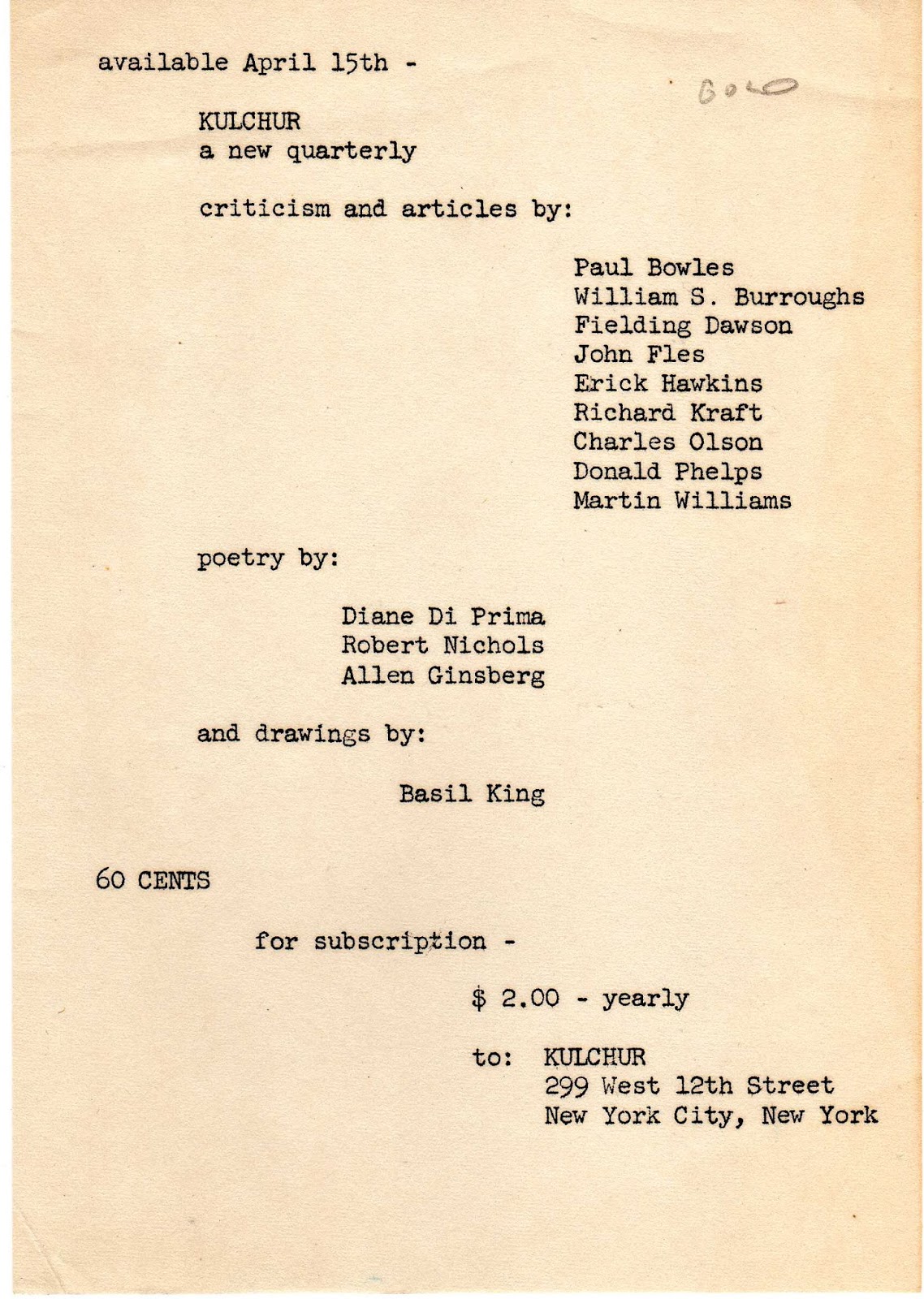
It would be an interesting project and Kulchur would be a good place to start since in the 1960s it was THE critical journal of the mimeo revolution.  It was conceived by LeRoi Jones and Marc Schleifer to be just that.  What follows below is poet Allan Kaplan’s review of the first eight issues of C:  A Journal of Poetry.  Today, it is hard to find a mimeo mag as revered as C.  In form and content it is considered a standout in 60s mimeo.  Kaplan’s review far from canonizes the magazine.  No doubt it is a positive review but there are some definite reservations and questions concerning the quality of the contents.  Not surprising since unevenness is the mimeo way.

I found the most interesting section of Kaplan’s review the last section.  I was shocked that there was mention of Joe Brainard’s covers but not a peep about the Warhol cover in Issue 4, particularly in that the review mentions Tom Veitch’s Literary Days in terms of Pop Art.  It also made me chuckle to have Kaplan piss all over Charles Olson.  I have written on Kulchur several times and I always come back to the fact that Kulchur as a magazine consistently denies its origins throughout the Lita Hornick years.  Read her memoir on Kulchur in The Little Magazine in America and it is not hard to understand why:  she hates and disrespects Marc Schleifer.  There seems to be a concerted effort to scrub him and his editorship from the record. 

The bad-mouthing of Olson by Kaplan is yet another example of this procedure.  Kulchur began as the critical arm of Yugen and LeRoi Jones idolized Olson and basically agreed to publish anything Olson produced.  Kulchur to some extent was created to give Olson a place to publish his unique brand of criticism.  Olson was a contributing editor to Kulchur from the start.  Olson oversaw the direction of the magazine and as I have argued on RealityStudio the eyes on the cover of Kulchur #1 are a reference to those of Olson as well as the idea of “the polis is eyes,” among other things like the critical eye and a jest that the mag will hear, speak and see no evil.  The first issue of Kulchur ends with an Olson punchline as masthead.  He is the mouthpiece of the magazine and breathes its purpose into being with this brief statement:  “(this is from Olson)  ‘reviews of the intellectual odor of our time.”  Funny then that Kaplan pooh-poohs all magazines that reek of the Big Man.

Kaplan’s review of C definitely erases Kulchur’s past.  It also looks into C’s future as a pivotal magazine for the next generation of poets, namely the Language Poets.  Kaplan’s review with all its talk of creating a new language could have come from a number of Bay Area mags from the 1970s.  There are any number of places a review like the one below can take you.  Like the magazines they analyze, such reviews are time machines:  They can take you back or thrust you forward.   After finishing reading Kaplan’s piece, where will you end up?

C, A Journal of Poetry:  No. 1-8, published monthly:  editors Ted Berrigan and others.


C is different from other avant-garde poetry magazines because its editors couldn’t care less about the development of the line as a poet’s natural breath, as the inviolable unit of his natural speech – in short, the popular legacy of Williams, Creeley, Olson, et. al. to a new generation of poets.

The following lines by a young poet who appears often in these 8 issues should give us a glimpse of what C is all about:


                                                                O scarcely

                                                verge o strings    Where is a new

                                                                beg of morning matin?

                                                                                “yes” of the hand?


                                                delve sky against     Nude

                                                mandarin d’étoile

                                                A tour of slept Sleptl:  the pacific

                                                     the vine of orange of

                                                                           sommeil


                                                made of dawn!        Rape of you you. . . .

                                                o the autumn sand


We can call the voice of Joseph Cerevolo that of a lyric poet even though there is no identifiable emotion as the subject of this poem, there is no believed (or despised) party to whom the poet addresses himself; nor is there a recognizable personality as narrator.  Stripped, as much as possible, of usual meanings, words evoke lyric feelings and suggest new meanings by appearing in original juxtapositions and contexts.   These few lines reflect some of the ideals for which many poems in C strive:  surprise, abstraction, purity, lyric joy, and complete uniqueness of expression.

                In a magazine with the bent of a robust distrust of logical thought to convey poetic truth is natural, a distrust which, of course, opens the mind to surrealism.  Here again the magazine rejects popular surrealist influences, Neruda, and Lorca.  What we find in C is a more elegant, post-Breton French variety.  (I am using the term surreal more as a loose description than as a rigid classification.)  Generally, familiar distinctions reminiscent of quiet prose or casual, civilized conversation are used to surprise the reader, often humorously, and to communicate a feeling which I can only describe simply as “oddly mysterious”  because it covers so many poets.  The following illustrations are by Tony Towle and Ron Padgett, respectively:


                                                Exactly one, at a time of morning

                                                In which the edge of the hill

                                                Is going down, and I was close

                                                To loving you for it.


                                                This is a tale then.     Good.

                                                The forest is important,

                                                The Boar hunt, and the close

                                                Of the legend.


                                                When by turns the leaves would arrive

                                                With the next nice October,

                                                And the king was away from our throats.


*        *      *

                                From point A a wind is blowing to  point B

                                Which is here, where the pebble is only a mountain.

                                If truly heaven and earth are out there

                                Why is that man waving his arms around,

                                Gesturing to the word “lightening” written on the clouds

                                That surround and disguise his feet?


                                If you say the right word in New York City

                                Nothing will happen in New York City:

                                But out in the fabulous dry horror of the west

                                A beautiful girl name Sibyl will burst

                                In by the open window breathless

                                And settle for an imaginary glass of something.

                                But now her name is no longer Sibyl – it’s Herman,

                                Yearning for point B.


                                Dispatch this note to our hero at once.


The cliché, and other forms of commonplace speech, also is used to couch the poet’s “odd mysteriousness” and to satirize the American scene.  Used without restraint these commonplaces can become metaphorized into a fey poetic diction.  For example, the novel Literary Days, long sections of which have been anthologized in C, is written in a compendium of all the familiar styles of bad prose, from the comics to the ubiquitous imitators of Hemingway.  Tom Veitch has written a novel that might be categorized as Pop Art. 

                This magazine eschews the profound poem, and it is important that we understand why.  As an example of profound, one might point to a Levertov poem profoundly lyricizing man-woman love or, say, sections of an Olson poem profoundly advising a young poet how to manage his affairs.  The C  sensibility would consider it truthful for Shelley to distinguish the profound from the lighter aspects of his life; but, considering man’s present comic relationship to society that grows absurder by the hour, is it real nowadays to separate the profound from the campy?  Are they separable?  To the editors of C many profound poems written today seem pretentious or derivative.  For C a more honest way to be profound in the 20th century is the poet’s expression of his “odd mysteriousness,”  which is the tapping of his own consciousness.

                Many poems in C succeed in what they attempt.  Certain voices will strike the reader as intriguing and worthy of attention.  However, many poems left me with a feeling of emptiness, seeming more like language calisthenics than poems or irritatingly arbitrary when they communicated no strangeness or surprise.  Their campiness, sometimes, just isn’t funny.  But this lack of consistency, inevitable, I suppose, when contributors sharing similar aesthetic ideas have varied talents or are of different stages of development, poses no real threat to the magazine’s goal of valuable originality, provided, of course, it continues to publish enough good material.  However, a threat lies elsewhere.

                I imagine much of the non-academic poetry which has sprung up as a reaction to the dull imitations of Eliot and Auden strikes the editors of C  as being in turn either second-class Pound, Williams, or Ginsberg.  But is it possible that some of C’s Young Turks will in turn be trapped in the same way as some of the poets who realized that Williams was one of America’s great poets?  C  is unique in that it is the only young-poet, non-academic journal inspired by the ideas and work of John Ashbery, Kenneth Koch, and Frank O’Hara, the leaders of the New York School, as Don Allen has grouped them.  (Incidentially, there are a number of excellent contributions by these poets in C.)  While reading C, it was my feeling that a number of poems slip past the line of being inspired by the original and, to varying degrees, are close to being adaptations of, say, Ashbery’s style.  Granted that these poems may be interesting in themselves and that the talent of the poet may be such that it is sometimes impossible to distinguish between master and disciple, nevertheless, this path in the long run leads to the shadow of Ashbery and not his substance.

                A happy impression one gets in reading through any issue is that it is fairly successful as a fountain of youth.  There is a willingness to play with words to discover what they might do – i.e. represent simultaneous thoughts, to make absolutely wacky, unproducable plays, etc.  Even the occasional appearances of poets such as LeRoi Jones and Ed Sanders, who write in a different manner, is accounted for, I think, by what the editors consider original in their use of language.  In fact C is a laboratory of language experiments that can be a source of ideas not only for the contributors but for the readers (assuming that many of them are other poets).  Even while in the process one becomes involved with a particular problem of what language can or can not do.  One might say that here language is “the thing itself” – rather than stance, line, natural objects, nature, one’s spouse, muses, the Bomb, America.  Indeed, the search for a new language becomes the search for one’s individuality.

                Mimeographed on 8 ½ X 14 paper, C has a tenement spun appearance and is too big to be put alongside your other “littles.”  If this dissuades you from bringing it home, let me add that C has two features (other than those I mentioned in this review) that will make it unique than most of the avant-garde poetry journals in your library.  They are:

1)      covers by artist Joe Brainard that are funny, sublime and beautiful.  (The covers merit a review by itself)

2)      no love letters to Charles Olson.


Allan Kaplan